The 7-Step Method to Choosing Your Dissertation or Thesis Topic
Stop spinning your wheels and start with a topic that’s clear, focused, and defendable.
Choosing your research topic is the single most important decision in your academic journey. It can be the difference between a focused, manageable study—or years of frustration and rewrites.
This 7-step process will help you choose a topic that is academically viable, intellectually fulfilling, and ready for approval. Whether you’re pursuing your master’s thesis or a doctoral dissertation, this method works.
Step 1: Master the Research Basics
Before you brainstorm topic ideas, make sure you understand the foundations of research. That means getting clear on:
- What constitutes a research problem
- The difference between qualitative vs. quantitative methodologies
- Common data collection tools like interviews, focus groups, and surveys
- Think of this as the blueprint. Without it, you’ll waste weeks chasing ideas that won’t hold up during proposal defense.
Step 2: Know Your University’s Requirements
Your university’s guidelines can make or break your topic. Some programs don’t allow certain designs (e.g., qualitative studies), or require specific ethical frameworks. Others require a particular level of originality or applied significance.
Action step: Review your dissertation handbook or committee guidelines now—not after you’ve spent months developing the “perfect” idea that doesn’t qualify.
Step 3: Identify Your Broad Areas of Interest
- Ask yourself: What topics make me curious—but that I can explore objectively?
- Go back through your coursework and recall the modules or theories that lit a fire in your brain.
Pro Tip: Don’t choose a topic that’s emotionally triggering or too personal. It’s easy to bring bias into the work if you’re too close to the subject.
Step 4: Review Past Dissertations
Head to your university’s digital library or ProQuest and skim through past dissertations in your field. Don’t read cover-to-cover—just look at:
- Titles
- Abstracts
- Introductions
This will help you see how others refined broad areas into narrow, defendable topics. You’ll also learn how much justification your university expects.
Step 5: Explore the Literature and Find Gaps
Use your university databases to locate 20 recent peer-reviewed articles in your interest area. Don’t just read for content, read for gaps. Look for phrases like:
- “Future research should examine…”
- “This was limited to…”
- “Few studies have explored…”
These gaps are your golden ticket to making an original contribution.
Step 6: Refine Your Topic Using These Techniques
Now that you’ve explored the field, it’s time to drill down and shape your actual research question. Use one (or more) of the following methods:
The FRIN Technique
- Look at the Further Research Is Needed section of journal articles and pull possible ideas from real gaps.
- The Contextual Lens
- Take a known theory or model and apply it to a new geography, population, or industry.
- The Dimensional Drill-Down
Ask yourself:
- Which profession? (Teachers, nurses, administrators?)
- Which phenomenon? (Burnout, resilience, decision-making?)
- What population? (First-gen students? ESL learners?)
- What setting? (Urban? Rural? Faith-based? Nonprofit?)
The more specific, the better.
Step 7: Evaluate Systematically
You might end up with three to five strong topic contenders. Don’t pick the one that “feels” right; score them across these three areas:
- Access – Can you reach the people or data you need?
- Capability – Do you have the skills (or time to learn them)?
- Significance – Will this matter to your field?
Create a spreadsheet and assign a score from 1–5 for each. Let the data guide your decision.
Want Help Applying This?
The hardest part of the dissertation process is finding a defensible research gap—and getting it approved.
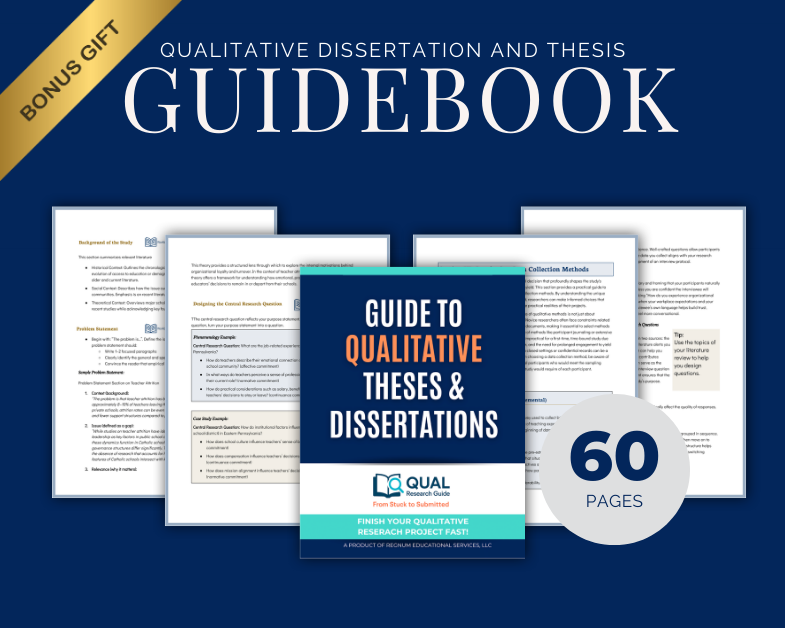
The Guide to Qualitative Dissertations and Theses + Workbook is packed with organizers, topic builders, and narrowing frameworks like these, plus spreadsheet templates to score and track your ideas. It’s built for students who want to get from stuck to submitted.
Let me know in the comments: Which step are you currently stuck on? You don’t need a perfect topic. You need a viable one. Let’s get you there.